
About SERV
Swiss Export Risk Insurance SERV helps to preserve and create jobs in Switzerland. It promotes Switzerland as a business location by making it easier for Swiss exporters to compete internationally.
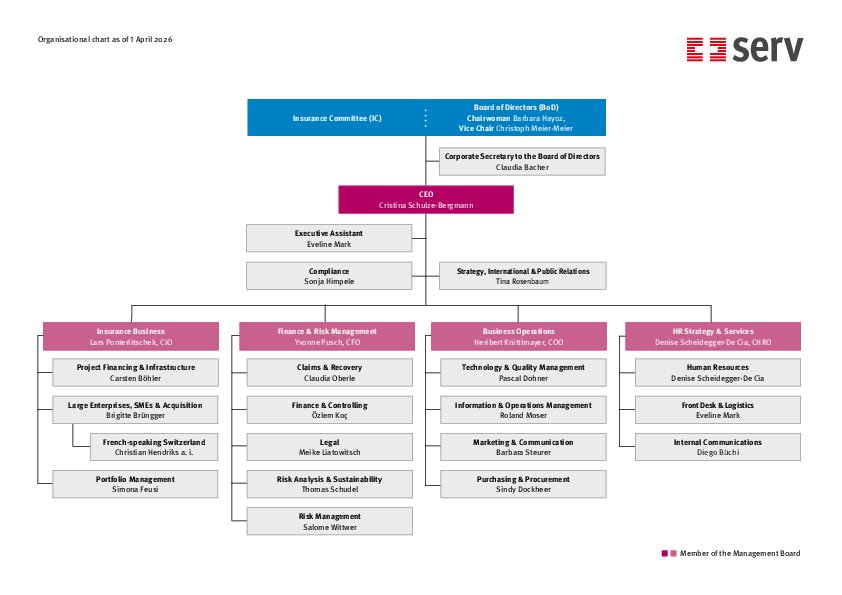
SERV is an institution under the public law of the Swiss Confederation and is independent in its management. The organisation is subject to the supervision of the Federal Council, which appoints the Board of Directors and defines the strategic objectives for four years at a time. Swiss Export Risk Insurance SERV supports Swiss companies with their export transactions and makes it easier for them to access foreign markets.
Strategic goals of the Federal Council
For the 2024 – 2027 strategy period, the Federal Council is continuing with its previous goals: SERV will continue to contribute to the creation and safeguarding of jobs in Switzerland while helping Swiss companies to gain access to major infrastructure projects abroad. SERV will evolve in its role as a trade facilitator. The Federal Council also attaches great importance to ensuring that SERV’s services meet the needs of the Swiss export industry and that SERV remains internationally competitive. SERV will provide the Swiss Confederation with early notification of significant and longer-term developments and propose relevant solutions. For more information, see the PDF (in German).
Legal basis for SERV’s activities
SERV’s business policy is derived from the SERV Act and the SERV Ordinance, as well as the strategic requirements of the Federal Council. The SERV Act also determines the basis of the requirements that an insurance transaction must meet. If these requirements are met, SERV is able to insure the transaction. SERV complies with the commitments that Switzerland has signed up to under international agreements, including the OECD Export Credit Arrangement and the Berne Union Guiding Principles.
Subsidiarity
SERV’s insurance policies are supplementary to those offered by the private sector (Art. 6 para. 1 let. d SERVG). In principle, it insures only risks that are not marketable or for which insufficient private insurance options exist. SERV bases its distinction between marketable and non-marketable risks on the European Commission’s communications.
Economic viability
SERV operates on the principle of economic viability. This means that SERV’s premiums and other income must be sufficient to cover the risk and operating costs – meaning it functions without taxpayers’ money (Art. 6 para. 1 let. a SERVG).
Swiss content
SERV covers export transactions that are of Swiss origin or include an appropriate degree of Swiss content; an appropriate share of Swiss content being at least 20 per cent of the export transaction’s order value.
If the proportion of Swiss content is less than 20 per cent, an export transaction may still be insurable under certain conditions and at the exporter’s request. Where this is the case, SERV checks whether
- the value-adding activities of the exporter in Switzerland are the decisive factor in the successful conclusion of the export transaction or the overall success of the company, and
- insuring the individual export transactions contributes to creating and maintaining jobs at the company in Switzerland.
Current issues
Reform project
The Swiss Export Risk Insurance Act (SERVG) is almost 20 years old, and has not been subject to a fundamental review since it came into force. Despite making full use of the framework conditions, SERV has to conclude that it is regularly and increasingly reaching its regulatory limits due to constantly changing external influences, which hinders and sometimes even prevents it from fulfilling its mandate of supporting the competitiveness of Swiss companies.
On the basis of clear indications from the business sector and several studies, SERV has concluded that a revision of the law is essential. The main objectives must be to:
- simplify eligibility requirements;
- make the range of services more flexible; and
- revise the institutional framework conditions.
There is no need for a comprehensive reworking of the SERVG. However, a targeted and focused partial amendment is needed to modernise the SERVG. Moreover, it needs to take particular account of SMEs, which can make use of more straightforward rules and products aligned with their requirements. The Swiss export industry should continue to compete internationally on equal terms.
Environmental and climate issues
The world is reacting to climate change and many countries, including Switzerland, have undertaken to adopt measures to reduce greenhouse gas emissions. With regard to environmental and climate issues, the Federal Council expects SERV to implement a sustainable business strategy within the scope of its influence for the 2024 – 2027 strategy period and to support decarbonisation as well as the transition to a green economy.
As an institution under the public law of the Swiss Confederation, SERV follows the foreign and climate policy standards of Switzerland and observes, inter alia, the relevant OECD Guidelines. The associated political decisions, as well as climate change itself, affect the business operation of SERV. SERV knows how important this topic is and takes every opportunity to increase its support for green projects, which are in the interests of and are in demand from Swiss export companies.