Solid fundamentals, increased geopolitical sensitivity
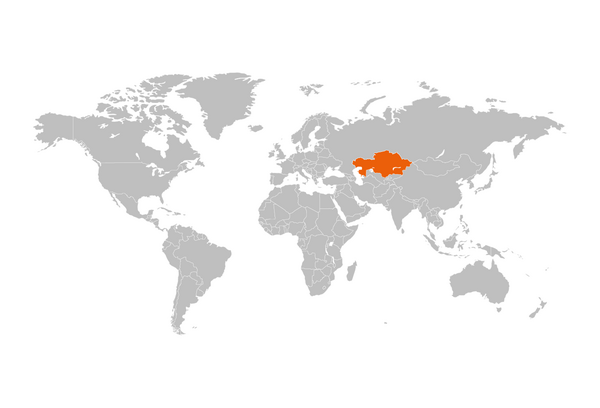
Kazakhstan combines economic stability with a strategic location and reform momentum. It presents attractive business opportunities for Swiss exporters, especially in industry, infrastructure and energy. At the same time, geopolitical dependencies, regulatory complexity and latent transfer and compliance risks require careful assessment and professional cover.
Central Asia’s key market with resilient momentum
With a gross domestic product of around USD 291 billion (World Bank, 2024), Kazakhstan is Central Asia’s largest economy. According to IMF data, its real economy grew by around 6.5 per cent in 2025, and international institutions expect growth of between 4 and 5 per cent for 2026. This is driven by stable exports of commodities, government infrastructure investments and the expansion of industrial value added.
The country’s macroeconomic stability is based on solid foreign currency reserves, moderate national debt and the National Fund, a sovereign wealth fund. For export-oriented companies, this speaks in favour of sustainable state payment structures. However, significant dependence on commodity exports remains a key factor affecting sensitivity to global price volatility and external shocks.
Diversification creates demand for Swiss technology
Kazakhstan is modernising its industry, energy supply and transport infrastructure with targeted reform programmes. In particular, the expansion of the Trans-Caspian Middle Corridor has been growing in strategic importance since the geopolitical shifts in the Eurasian region.
There are attractive opportunities for Swiss companies in technologically challenging segments – particularly where precision, operational safety and efficiency are key. Significant potential can be found in mechanical and plant engineering, industrial automation, energy and environmental technologies and the expansion of digital and medical infrastructure.
Demand is increasingly focusing on high-value special solutions with long-term productivity benefits.
Geopolitical complexities mean greater care is needed
Kazakhstan continues to pursue a multi-vector foreign policy between Russia, China, Europe and regional partners. This strategic balance strengthens the country’s economic resilience but also increases its geopolitical sensitivity.
For Swiss exporters, this means a greater need for compliance audits, end-use declarations and the careful analysis of payment and supply-chain structures. Particularly in the case of cross-border transactions, Kazakhstan’s proximity to Russia increases the importance of regulatory control mechanisms and requires systematic sanctions and counterparty due diligence.
What does the cover policy for Kazakhstan look like? Find out more here.
Operating environment with selective risk profile
Kazakhstan has improved its investment conditions in recent years and expanded its digital administration processes. Nevertheless, the institutional environment remains challenging in some respects.
Regionally inconsistent official practices, regulatory predictability, the enforcement of contractual claims and the tenge’s exchange rate volatility continue to present challenges. In addition, transparency in private counterparties is sometimes limited.
Resilient contract structures, thorough credit checks and structured payment cover therefore remain key for capital-intensive export transactions.
Assessment for Swiss exporters
SERV classifies Kazakhstan as a fundamentally viable market with a selectively attractive risk profile despite increased geopolitical sensitivity. Technology-oriented export transactions with government or institutional counterparties of high credit quality and clearly structured payment mechanisms are particularly promising.
Market entry is recommended subject to careful market assessment, clearly defined contract structures and systematic risk cover of larger receivables.
Kazakhstan offers Swiss companies substantial business opportunities – but sustainable success requires selective market development, stringent risk analysis and consistent transaction cover.
Find out more about SERV’s risk management.