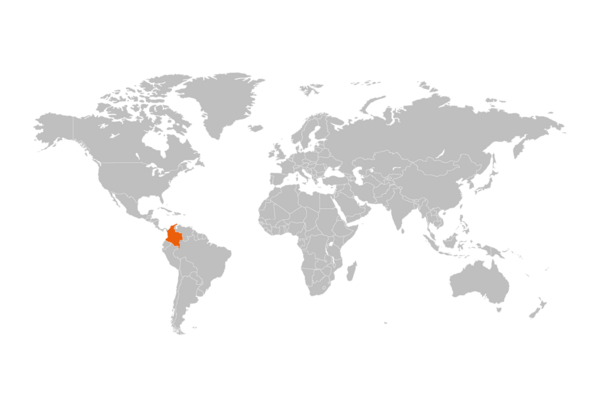
Diversified economy facing fiscal adjustment pressure
Colombia is one of Latin America’s largest economies and offers Swiss exporters attractive business opportunities in an increasingly diversified market.
Despite fiscal challenges and political uncertainties, the country remains economically resilient. At the same time, over the past two decades, Colombia has increasingly evolved from a traditional developing country into a regionally important business and investment location. This opens up interesting prospects for exporters, particularly in the fields of infrastructure, energy, industry and environmental technologies – provided that the risks are managed professionally.
Solid economic structure supports demand
Colombia has a broadly diversified production structure. In addition to oil and mining, industry, agriculture, services and consumption make a significant contribution to economic activities. On the export side, however, concentration remains high. Fuels and extractive industry products accounted for around 38 per cent of the goods exported in 2025.
The International Monetary Fund (IMF) expects real economic growth of 2.2 per cent in 2026, following 2.6 per cent in 2025. Nominal gross domestic product is around 570 billion US dollars (IMF World Economic Outlook, October 2026). At around 6 per cent compared with the previous year, inflation remains twice as high as the central bank’s target of 3 per cent. The key interest rate of 12.25 per cent makes investment and financing more expensive.
Despite these challenges, Colombia has well-established institutions, a developed financial sector and a large domestic market with a population in excess of 53 million. Since joining the Organisation for Economic Co-operation and Development (OECD) in 2020, the country has implemented numerous economic and institutional reforms and further strengthened its international competitiveness. This creates relatively stable economic framework conditions for long-term business relationships.
Opportunities for Swiss companies
Economic development and the need for modernisation are creating attractive market potential in several areas. Swiss suppliers have good prospects in the market – especially where technological specialisation, high quality standards and long-term operational reliability are required.
The expansion of transport infrastructure, logistics centres and energy and supply infrastructure is increasing demand for technology, engineering services and specialist equipment. At the same time, the country is investing in the energy transition and the expansion of renewable energies, particularly in solar and wind energy projects. The OECD also sees considerable need to modernise transport and trade infrastructure and to reduce administrative barriers to trade.
Economic ties between Switzerland and Colombia have been continuously deepening in recent years. Switzerland is one of the most important foreign investors in the country. The free trade agreement between the European Free Trade Association (EFTA) and Colombia and the bilateral investment protection agreement create additional legal certainty and facilitate market access for export-oriented companies.
The following areas are particularly promising for Swiss companies:
- Infrastructure and transport projects
- Energy supply and renewable energies
- Mechanical and plant engineering, including industrial automation
- Water and waste management
Moreover, demand is growing for sustainable production processes, environmental technologies and ESG-compliant solutions. Gradual alignment with international sustainability standards is creating additional entry points for Swiss companies with technologically advanced and resource-efficient solutions.
Fiscal risks and political uncertainties remain relevant
The SERV country analysis considers high budget deficits, rising financing costs and the necessary consolidation of public finances to be the greatest economic risks at present. The budget has widened significantly following the suspension of the fiscal rule in 2025. President Abelardo de la Espriella Otero’s government, which has been in office since August 2026, began talks with the IMF at the end of September. A credible adjustment programme could stabilise financing conditions. However, the risk of late payments by public sector principals remains high until agreement is reached.
Operational challenges also remain. These include complex administrative processes, regional infrastructure shortcomings and stricter compliance requirements. Regional security risks remain, but they primarily affect individual parts of the country and are so far only having a limited impact on macroeconomic development.
Assessment for Swiss exporters
Swiss Export Risk Insurance SERV still sees Colombia as an attractive market with a balanced risk-reward profile. The country risk category 4 corresponds to a medium risk level, which is manageable for many export transactions. The cover policy is open. In view of the tight budgetary situation, a particularly careful assessment of budget availability and solvency is advisable in the case of public sector orderers.
The combination of a large domestic market, economic diversification, infrastructure requirements and the energy transition presents interesting business opportunities for Swiss companies in the long term. At the same time, fiscal challenges, regulatory uncertainties and higher financing costs require careful risk analysis and professional structuring of export transactions.
Business Opportunities in ColombiaOur partner Switzerland Global Enterprise (S-GE) provides information on exclusive business opportunities in Colombia. |